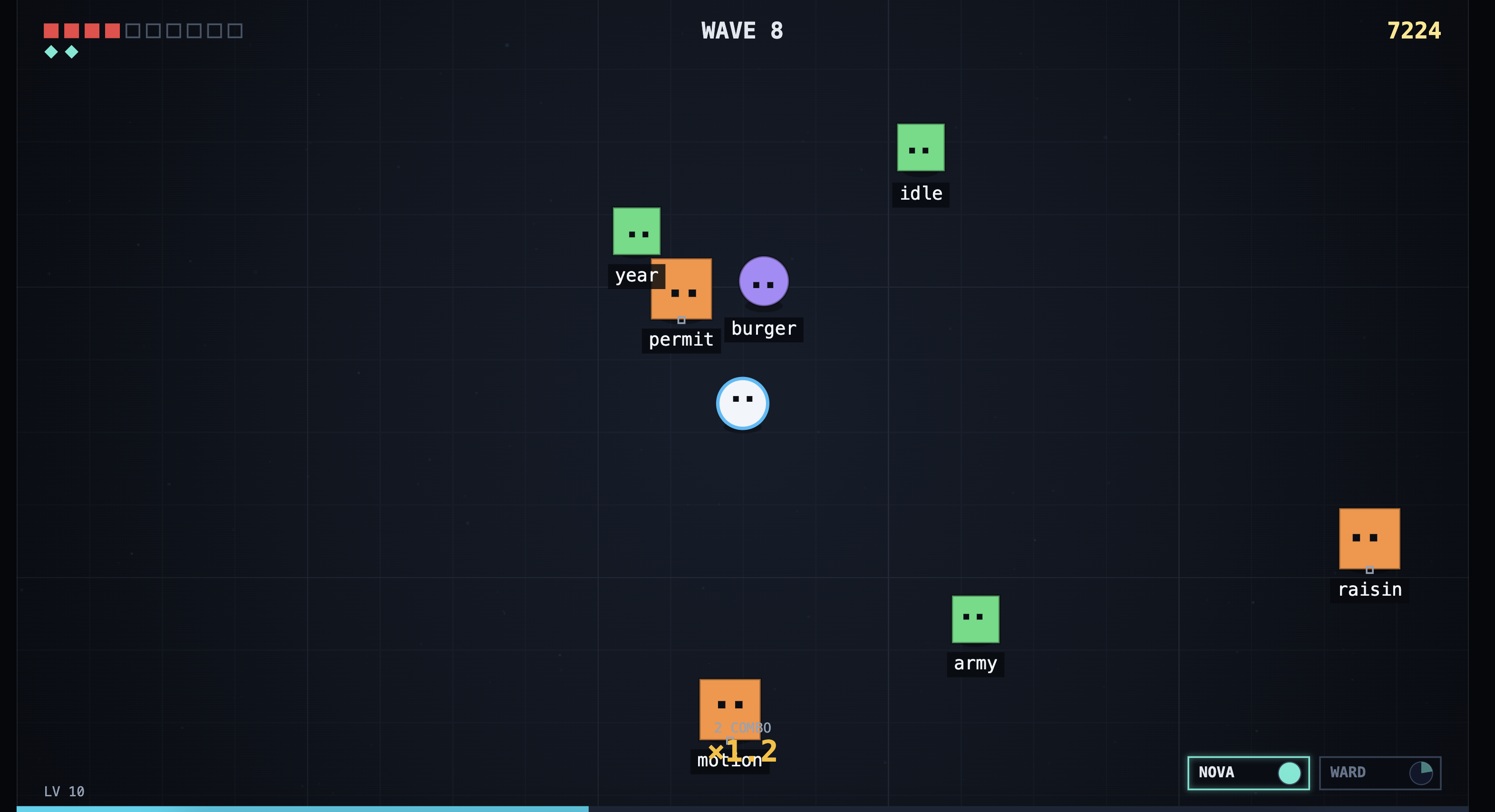
A few weeks ago I built a small typing game called Typocalypse and posted a demo of it on Reddit and Hacker News. The posts have been viewed around 20,000 times, the game got a steady stream of players, and I collected more useful feedback in a week than I could have generated alone in months.
This post is about how that happened. The game itself is almost beside the point here. The same approach works for practically anything you can put in front of strangers: a game, a CLI tool, a SaaS landing page, a weird little website. If you want to find out whether people care about the thing you’re building, you can get a first answer within days, and coding agents have made the “building” part of that loop absurdly fast.
From idea to playable in about six hours
The demo took me roughly three hours to get from idea to a first playable version, plus another two to three hours of polish to remove the most annoying bugs. I built it with Fable 5.
I started by writing down some loose thoughts about the game I had in mind. Then I ran Matt Pocock’s grilling skill, which makes the agent interview you about your idea until it actually understands what you want. It asked me a bunch of questions about the gameplay, the look and feel, the scoring, and so on.
From there I had the agent break the project into work packages, written as plain markdown files inside the repo. No Linear, no Jira, just a folder of files describing what has to be done. Then I asked it for the dependency graph between those packages and what could be built in parallel. One agent built the foundation of the game first. Once that was in place, I sent off several agents at the same time, each implementing one work package.
That got me to a first working version very quickly. I played it, found a few things that annoyed me, and cleaned those up in a couple of follow-up sessions. Then I recorded a video and wrote my posts.
All in all, about six hours from the first idea to something I could put in front of people.
Where I posted, and what happened
I posted in three places and asked a genuine question in each: what can I improve, what’s missing, are you having fun?
- r/SideProject: about 17,000 views, around 90 upvotes, and 37 shares. Shares are my favorite metric here, because every one of them is a person forwarding the game to someone else.
- r/vibecoding: about 3,000 to 4,000 views and around 15 upvotes.
- Show HN: 5 points and a handful of comments.
The Reddit posts led with a 20 to 30 second video of me playing the game. I recorded it with the Windows Snipping Tool, which tells you everything about the production value (xD). I can’t prove the video is what made the posts take off, since I never ran a version without one, but I’m fairly convinced. A short clip lets people experience the thing while scrolling, and playing a demo is a much smaller ask once you’ve already seen it in motion.
On Hacker News that wasn’t an option: a Show HN is just a link and a bit of text; there’s no way to attach a video. The post stayed small in points, but the comments were detailed and useful. Posting to all three places cost me maybe half an hour.
The feedback
The views were nice, but the feedback is why I posted in the first place. Here’s one of my favorite comments:
The power-up that automatically kills a nearby weak enemy is BRUTAL for anyone who types fast and mentally queues up the next word while typing the current one. I’ll finish killing one enemy, immediately start typing the word for the next-nearest enemy, only to realize it’s already dead and I’m four keystrokes in. There goes the combo.
I would never have found this myself, because I don’t type fast enough to trigger it. One comment from one fast typist exposed a design flaw in a power-up, and I plan on shipping a fix for it.
Other feedback gained weight through repetition. Several people independently told me it was unclear how to trigger the active abilities. That made it obvious that this feature needs an explanation.
And then there were the comments that simply told me the idea works. My favorite came from a Korean player on the vibecoding post (translated from Korean):
I had a lot of fun playing. I got so into it at work that I got told off for my keyboard being too loud haha.
If someone on the other side of the planet gets scolded at work because they can’t stop playing your demo, the idea is probably worth pursuing.
And on Hacker News, one player made it to wave 37 and left a structured list of issues. Two of the bugs on that list I had already found and fixed on my own before reading the comment. Watching strangers and me converge on the same problems independently was oddly reassuring. It meant the feedback loop was pointing at real things.
This is what a public demo buys you: a ranked list of which bugs actually hurt, which features people ask for unprompted, and which design principles to commit to. I’ll write a follow-up post that goes deep on exactly this: how I turned these comment threads into concrete changes and what I decided to ignore.
Things I never saw coming
The posts also triggered a few effects I couldn’t have planned for.
Typocalypse got added to HN Arcade, a curated collection of games built by the Hacker News community. Someone else decided my game belonged in an archive. I found out from a comment under my own post.
Someone who runs his own collection of arcade games reached out and invited me to contribute. I passed on it, but the fact that a six-hour demo generated an inbound collaboration offer surprised me.
And my favorite one: while looking through Vercel Analytics, I noticed referral traffic from a domain I didn’t recognize. The game had made it into a newsletter, as far as I can tell, a Chinese one. My little typing game traveled to a place I’ve never been, in a language I don’t speak, and I only found out by reading my referrer logs.
None of this was plannable, and none of it would have happened if the demo had stayed on my machine.
What the traffic did afterwards
In the week after posting, about 100 people visited the game per day. After a week it was around 50 per day. Now, three weeks in, it has settled at roughly 15 visitors a day, without me doing any further promotion. The spike decayed, as spikes do. For a demo that took six hours and had zero marketing budget, 15 strangers a day still showing up feels like a gift.
Just post it
I posted Typocalypse because I was curious what would happen, and every possible outcome of that experiment was interesting to me. Even total silence would have been useful information.
So here’s the playbook, which applies to far more than games:
- Build the smallest version of your idea that a stranger can experience. With coding agents, this is now a matter of hours.
- Record a short clip of it. Mine was 30 seconds out of a screen recorder that ships with the OS.
- Post it where curious people already gather, and attach the video wherever the platform allows it.
- Ask a real question.
Then read everything people write back, because that’s where the value is. In the next post I’ll show how I used exactly this feedback to decide what to build, what to fix, and what to leave alone.
Until then: Typocalypse is right here. If you find a bug, you know where to find me.